
In the States, I designed people’s houses in Carribeans and the local designers developed into detailed construction drawings based on my design concepts. In Asia, I drew construction drawings based on American designers’ design concepts. I am still me. What changed?!
Author Archives: Dawen Huang Interior Design
Recent Protest in Taiwan
Recent protest in Taiwan made headline news because of the trade agreement between Taiwan and China. I can understand why many people in Taiwan are scared and frustrated. No doubt the economy in Taiwan will be boosted after this agreement is signed, but after seeing how Russia used its economy influence to screw up Ukraine. Increasing economy dependency on China after the agreement is signed will lead Taiwan to a very disadvantage position in the future if China decides to forcefully take over Taiwan. Taiwanese people’s concerns have become very understandable.
If you ask a group of 10 in the US has anyone been to China? 6 out of 10 people will most likely say yes, but when you ask the same group of people if anyone has ever been to Taiwan? it will be very lucky if one person says yes.
When visiting China, I realized there were so many things there looked like they were from China but actually were from Taiwan. You might say, Taiwan is a part of China. Well, according to Chinese government and many ass-kissing governments in the world, it is, but for the government and the people in Taiwan at least, those days that Taiwan belonged to China were just a remote memory, just like the United States to the United Kingdom, or Norway to Sweden.
Since the Nationalist party led government of the Republic of China lost the civil war in 1949 to Chinese Communists, The Nationalist government retreated (escaped) to Taiwan and settled there till today. In all these years of separation, the Nationalist government had successfully defended Taiwan against Communist military’s attack in 1958, and transformed itself from an authoritarian government to one of the most dynamic democracies in the world. The Republic of China or R.O.C., according Chinese Communist version of history, has eliminated by the People’s Republic of China or P.R.C. in 1949, but in reality, the Nationalist party led R.O.C. survived the 1949 Civil War and flourished in Taiwan till this very day.
China opened its door to the rest of the world in the late 80’s and started to establish some communications with the Nationalist government in Taiwan. Since then, China started to send scholars and historians to Taiwan and re-learned the Confucianism and other Chinese traditions and histories that were wiped out during the event of Culture Revolution in China but preserved in Taiwan. Taiwanese businessmen also started to establish businesses in China and introduced the free market system to China years before any other country entered the Chinese market. Taiwanese food, local culture, drinks, pop musics, TV programs, movies, and even slangs, all started to get into China.
When I visited China, I constantly heard Taiwanese songs sang by local singers, TV programs looked so much like Taiwanese TV programs many years back, and popular Taiwanese small eats such as bubble tea and pineapple cakes. Maybe some of you will think it is great to see these things unique to Taiwan are flourishing in China, but I fear Taiwan has started to lose its identity and visibility in the world.
As I have mentioned in the beginning of this article, most of the visitors around the world have visited China but not Taiwan, many of those visitors will never know many of the culture and history stuff in China were restored with Taiwan’s help, and they will never know those pop musics, food, drinks, or restaurants they enjoyed during their visits were actually originated in Taiwan. Once again, Taiwan has disappeared in the world just like it had back in 1949. Chinese government has even changed their police and military uniforms to look like those in Taiwan and imitated Taiwan’s health care law, road system, food culture, and so on…. for only one purpose, to confuse the world and make Taiwan less visible to the world as a different sovereignty but just a part of China. For many, disappearing of Taiwan is just one of China’s domestic affairs, but for the people in Taiwan, it means a democratic way of life is taken away from them forever.
Unreasonable Fast-Paced Schedule Affects the Quality of Design
Even though Shanghai has great infrastructure, the quality of it is just very poor. The subway for instance, the design is so old fashioned and the materials look so outdated. Many platforms look very dark due to poor lighting design, the floor looks dirty and old due to the fading colors of the stone slabs. The numbers of the escalators and stair cases are not proportioned. The floor layouts and signages are confusing. Restrooms and elevators are also difficult to find. The train carts are relatively small compared to the large volumes of commuters in the city. The seats and pathways are very narrow and the light fixtures always blocked the view to the posted ads or the route maps on the trains. The design just does not exist. You can very easily tell the entire subway system was built in very hurry without any deep thinking through in terms of functionality or aesthetic. I always thought the subway system in Shanghai has been built for at least 20 years or older, but I was shocked to learn the construction for the entire subway system in Shanghai did not start until the beginning of ’00. Oh my…. I have nothing to say.
The Definition of Foreign Designer in China
Many people thought a designer like me, an America educated and trained designer, would have more advantages over the local Chinese designers in China.
Well, I disagree because I was paid like a local designer, and my designs were criticized like a local designer. I was also asked to copy the designs from American design magazines. Meanwhile, a Caucasian person who does not know anything about interior design was hired and paid as an American interior designer, and his responsibility? Going to client meetings and just sitting there doing nothing to give the clients the impression that the design firm is more “international”.
I always heard people said “It is a privilege to be born as a white person” in the US, but I disagreed with it strongly because I was treated and paid no less than any Caucasian designer in the US, but I never expected the same saying would fit in China perfectly.
High End or Low End?
When working on a project in China, I heard a worker from a millwork shop said the shop was planning on getting rid of Formica laminates because they were too expensive and too high-end.
That was one of the realities I had to deal with when I was working on projects in China. It seems like everything has a cheaper replica in China. When I specified commercial grade materials from the US in China, the local vendors always could find some alternatives that looked similar or the same but half of the cost. Every commercial grade material I had specified in the US became the material for high-end residential projects in China. Now, I am curious what kind of stuff the designers specify for high-end residential projects in China?
Patriotism or Nationalism?
There is one thing I do not understand is while many Chinese people are trying their best to emigrate and send their kids overseas to become foreigners, many of them are still wanting Taiwanese to be Chinese. If Chinese people do not even want to be Chinese, why Taiwanese people want to be Chinese?! I am puzzled.
Misunderstanding of Green Design
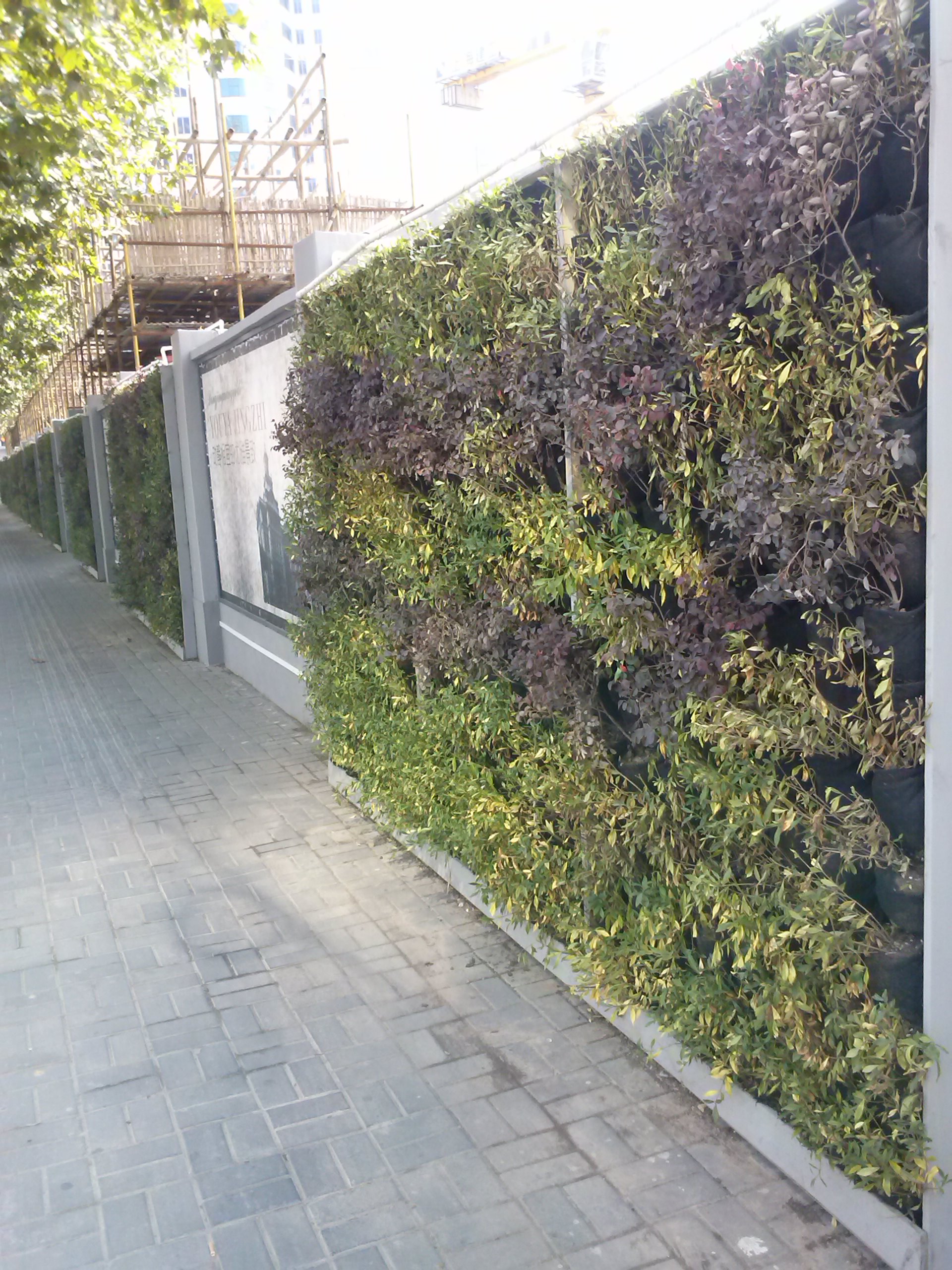
Green Wall LEED?
You can spot a lot of this kind of walls with plants in China. The reason why many businesses there like this feature is to give the general public the business impression of caring for the environment, but for me, it is just another example of misunderstanding of green design.
When you see this kind of plant wall on a building, it serves a purpose which is lowering the interior temperature when facing the right direction. Therefore, it helps reducing the interior temperature and cutting down the electricity used on AC for the building. It will also reduce the sunlight reflection bouncing off the walls so the temperature surrounds the building will not increase drastically which might contribute to Head Island Effect. Well, the other side of the plant walls in the photo is a construction site.
Also, those plants are not the plants that you can just leave them along without giving them water, and the water they used to irrigate these plants is clean water, not gray water or rain water harvested. So, they are actually increasing the burden for natural resources on earth. Therefore, these walls might look nice but do not have any value in terms of earning LEED points or have anything to do with green design except they look green, color wise.
Fight against Copy Cats
As an American interior designer worked in China, I know too well about the culture of copying someone else’ designs over there. You might think the designers in China who copy other people’s designs are not creative, but in fact, I have worked with many creative designers in China, so how come copying designs become so popular and it turns into the business norm for the interior design industry? Here are the reasons:
- Extremely unreasonable deadlines: People around the world all have witnessed China’s rapid economy growth in the past two decades, there was a reason for that. If you can move from one project to the next faster, it means the more money you make, to both the design firms and the clients, so the time schedules set by the clients and the design firms usually are very tight compared we do projects in the US. You can easily find a 1-year long project gets done in 5 months in China. As we all know, a quick design idea might only take few minutes to generate, but a very well thought through design concept takes time, and there is no such luxury in China to allow designers really thinking deeper, so the best way to cut the corner is to copy or tweak other people’s designs.
- Client’s requests: Unlike most of the clients I have worked with in the US who appreciated my creativity to come up with the ideas that no one else had ever thought about, the clients in China often demanded their designers to copy other people’s designs from the design magazines they read, the hotels they stayed or a store they visited. The most funny thing was one of the Chinese clients wanted me to copy a design from a design magazine and it turned out the project he wanted me to copy from was one of the projects I designed when I was working for another designer in the US.
- Lacking 3D perception: Most of the clients I worked with or the employers I worked for in the US could visualize my design ideas simply with a free-hand sketch or a little better made hand sketches for the initial design presentations, but in China, because many clients and the designers alike never had any art or design related training, they just can’t visualize the designs without seeing a super realistic 3D color rendering done by the computer program like 3D Studio Max. As everyone knows, it is very time-consuming to generate a 3D Studio Max drawing, it is just not cost-effective, especially for the initial client meetings. So, looking for reference photos on-line or on magazines and using them as part of the design presentation becomes extremely popular and cost-effective way in China to conduct the initial client meetings. If the clients like the designs in the project reference photos, the designers are forced to go along with the design concepts or details done by other designers showing in the photos which indirectly turns the interior designers into interior copiers or interior tweakers. You might ask why those designers do not use their own old project photos? well, they do! but those old projects were also copied or tweaked from other designers’ projects. Even if some creative designers in China came up with some great ideas, their designs never could be approved by their employers because their employers could not visualize the designs without a computer generated color rendering either, and no one has time to make their design concepts in 3D Studio Max just for trying to persuade their bosses to approve the designs so that they could present them to the clients, as the result, many great creative designs never even got the chance to reach the clients before being blocked by their employers. Frustrated, many designers in China start to look for reference photos for design ideas instead of creating their own.
- Excessive overtime working: Because the super fast paced work environment in China, many designers are forced to work overtime constantly, 60 or even 70 weekly working hours are very common, the fatigue and stress caused by long working hours inhibited and even further damaged the designers’ creativity.
There are so many creative individuals in China who want to create but can’t. They are frustrated, over worked, and under paid. So, instead of criticizing the designers in China for being copy cats, we should blame those few on the top who made the designers copy cats.
Does long working hours translate to real profits?
These are the 10 most influential brands in the world according to the April 2, 2013 article by Kochie’s Business Builders:
1. Google
2. Microsoft
3. Apple
4. Facebook
5. Visa
6. Coca-Cola
7. Samsung
8. YouTube
9. MasterCard
10. P&G
After I saw this result, I am puzzled because there is only 1 Asian Company on the list. It can’t be because most Asian businesses have the tradition of working overtime. Longer working hours means higher productivity which many Asian businesses deeply believe. So, based on that theory, it should have more Asian businesses on the list.
We also can see most of the companies on this list are American businesses and most American businesses do not promote working overtime. I think for many Asian business owners, this list must be wrong.
The True Productivity
There are a lot of businesses out there still believe working overtime can increase productivity but fail to realize productivity should not be measured by how much is accomplished alone, how much time spent on fixing the mistakes and revising bad ideas should also be considered.
For example, if a set of construction drawing normally requires 7 days to finish but you push your designers to finish it in 3 days, maybe your designer can finish it in 3 days as you requested, but you might want to consider if any error or bad design has occurred due to the fatigue your designer sustained because of long working hours.
If your designers spent 3 days to finish the drawings but spend another 5 days worth of work on correcting mistakes or stupid designs, arguing with contractors/vendors, and apologizing to the clients, then you must calculate the total time spent on this construction drawing set as 8 days, not 3 days anymore. This sounds like a no-brainer, but many employers out there are still ignoring it and deeply believe by working overtime, they can get more things done and fail to realize it is just absolutely an illusion.
 Dawen Huang Interior Design