
There are lots of mediocre stuff going on in the interior design world, one example is to design a space with Oriental elements. One particular thing that disturbed me was seeing the cut-off Buddha’s head displayed on a stick. I studied European or American art and architecture history for a while and never saw designers displayed any chopped off Jesus Christ’s head on a stick. I personally think it is a very disrespectful practice and I do not think the designers who designed this kind of element fully understand the content of Asian culture which reflects what I just mentioned, mediocre.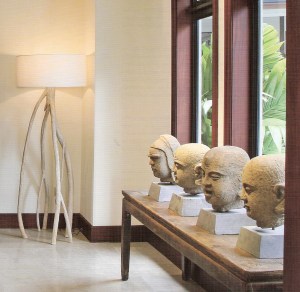

Category Archives: Interior design business
Smarter Designers Don’t Copy
The designers in Asia usually copied American or European designers’ designs to make profits, and many Asians think they are smarter by doing this since they can make money quicker by saving time on research and design development, but is it really true?
American or European designers often enjoyed the profits from the patents, but for Asian designers who want to make profits without holding patents, they must work harder and faster in order to produce someone else’ products to make profits, so they often have the workers work overtime to pick up the production, as we all know, working overtime eventually kills the creativity, so Asian designers will never be creative enough to come up with any break-through invention so that American and European designers will always have the leading edge on innovation, and because the American and European designers are making profits from the patents, they do not need to work overtime to generate enough profits which allows them having more flexible time to think, invent, and come up with the next patented inventions to monopoly the markets.
American and European companies also can sue Asian companies for violating copy rights which will also divert the Asian companies’ resources and time from research to defending the lawsuits which will further damage Asian companies’ ability to innovate. If a design company’s design ability got fundamentally destroyed which will be like you are taking the heart out of a living person. Now, who is smart?
Sales, Sales, and Sales
Throughout my design career, I have met many people from different companies, Audio/Visual companies, lighting design firms, general contractors, or kitchen companies, during the initial contact, I always met the people who sounded very knowledgeable, they always presented themselves with great knowledge and also very persuasive. Their sales and marketing skills were excellent and always made the impression that they are trustworthy and professional.
However, after working with some of the companies for a while, I started to realize some issues occurred such as the things were not coordinated or followed up properly, and when the clients and I questioned about the issues, they always showed the great skill to calm you down and ensure everything will be fine with sweet, smooth, and very diplomatic talks, and when the clients and I finally realized the issues were more serious and complained to the owners of the businesses, then all over the sudden, those talkative people just disappeared, instead, the real knowledgeable people started to show up at the job site to solve the issues, and when I asked them why we had never been told about all these problems earlier by those sweet talkers from their companies? they basically said “Oh! He/She was just a sales, so he/she would not have known all these!” What?! a sales? I was very serious here about the issues, and the whole time I had been talking to a sales?!
I had to admit I got fooled few times like that, the people from certain companies I had dealt with were actually sales, but they talked so smoothly, I mistakenly thought they were the actual engineers or technical people, but the funny thing was, those real technical people and engineers usually were the people with few words.
Lesson learned: those who talk the most usually the ones know the least. When I hire anyone from now on, not only I want to know the company owner or the front man but the people who will actually do the work. Sometimes when some businesses are well-known, it is not because they are really good at what they do but because they are good at marketing. We must overcome this blind spot when hiring any professional.
Advice for American interior designers who want to work in China
1. If you would like to work in China as an interior designer, first of all, you will need to know how to use multiple computer added drafting softwares, here are the 4 programs you must be able to use, yes, ALL 4 of them: AutoCAD, Adobe Photoshop, Adobe Illustrator, and 3D Studio Max, and it will be a big plus if you can operate them super fast. Revit or SketchUp? sorry, they are not popular in China.
2. You do not need to be creative. Most of design companies in China encourage copying other people’s ideas because it is faster. Project pace in China is 10 times faster than in the US, they just do not have the time for the designers to generate design concepts of their own, so copying design ideas from magazines or other projects has become the norm. Also, if you show your employer a very unique design idea, your employer will most likely to ask you show him a photo of your design ideas. You might feel strange because how you can have an actual photo of your design ideas if it has not been built unless you copied other people’s design ideas from design magazines? That is because many employers there also do not like to take the risk to build anything that no one else has ever built before because it will take too much time to figure out how to actually build it, so if you come up with a design idea that is like a pioneer, your idea will most likely to be turned down.
3. You must be able to endure long working hours. Working overtime without overtime pay is very common in China. Because the project pace is fast, designers are constantly working overtime during the weekdays, on weekends and National holidays. Do not be surprised if you are asked to work overnight to finish a project without sleeping constantly.
4. You must be able to accept lower salary. The income level in China is not as high as in the US, so your salary there will more likely to be lower, but you definitely will feel better since the cost of living in China is also lower (except those big coastal cities such as Shanghai or Guangzhou).
5. You need to adapt the society well. Air pollution, dirty streets, crowded subway, hazardous drinking water, poisonous food, cars run over red lights, cars do not yield to pedestrians and horn constantly, people spit, liter, urination in public, jay walking, cut in the lines….etc. If you can get over these things quickly, then your life in China will definitely be much happier.
Interior Design Company Cultural Differences
Advice for the interior designers in China who would like to work in the US:
Working overtime voluntarily in Asia is often portrayed as the workers’ strong devotion and dedication to work hard for the companies while working overtime frequently is a sign of inefficiency in the US.
Most of American businesses are running based on 3 principles, Efficiency, Innovation, and Elimination of Competition, so every company policy was designed exactly for achieving these 3 goals. For instance, many people think American businesses do not like their employees to stay at work late or work overtime is because America has more stringent labor law and many American companies do not want to pay for the overtime pay. Well, yes, it might be part of the reason, but there are more to it.
1. Efficiency: First of all, the companies I had worked at in the US, none of them actually paid for the overtime pay, but how come none of my ex-employers ever asked me to work overtime? in fact, throughout my 14 year career in the US, I probably had worked overtime less than a week if you put all of my overtime hours together. American companies believe the longer you work, the less efficient you become, when people get tired, they have hard time to stay focus, and their pace will get slower but the chance of making mistakes will increase. American businesses expect you to work with 100% efficiency when you are at the office, if you are not performing at the top condition, you are just wasting time. That is why the US companies also do not like their sick employees to show up at work. Because they do not want a dizzy zombie-like person at work who probably will waste a lot of time on blowing his/her nose or rushing to the restroom every other minute and give the virus to other workers and make them sick and become ineffective. Basically you can just call in and tell the company you are not coming in to the office just because you do not feel like working today in the US, why? because American companies think if your mind is not here when you are working, you are not effective, you are wasting time here in the office. Many American businesses give their employees 5 sick/personal days in addition to the 2-week paid vacation days is exactly for that purpose. Now, for increasing the productivity, some companies are giving employees extra time to take a nap after lunch.
2. Innovation: Research also shows most of creative and innovative ideas happened when people were outside of offices during non working hours. So, American companies want their employees to enjoy their personal lives. They do not believe keeping employees at the office for longer working hours has any positive impact on being creative or innovative.
3. Elimination of Competition: Sung Zu’s The Art of War says The best way of defeating the enemy is to defeat the enemy without sending out a single troop. American businesses definitely follow this ancient principle from China. The best way to defeat your business competitors is not to compete with better products or services but not even let the competition happen at the first place. Many American tech companies often filed suits against their foreign competitors over the copy right issues to keep the competition out, and many products made by foreign competitors can not even be imported to the US market because of the violation of copy right. Endless lawsuits also weakened their business competitors’ ability to compete because their competitors had to spend more time and resources on defending themselves at the court but less on developing new technology. American businesses treat their employees not only as partners but also as competitors, prolonged working hours creates dissatisfaction towards the working environment which usually caused employees to quit their jobs and work for other companies or start out on their own, no matter what, these employees eventually will become the competitors directly or indirectly. Many states in the US requires commercial interior designers to have state issued licenses in order to practice, it is also another way to keep more competitions out.
Of course, high health insurance cost in the US is also a major factor that American businesses have to make their employees work very efficiently because keeping the numbers of full-time employees down will save money on the employees’ health insurance premiums, and they definitely do not want their employees to get sick all the time because of long working hours which will also drive up the employees’ health insurance costs.
So, if any of you have the opportunity to work in the US, do not think your employer will be happy and appreciative to see you or people working under you working overtime constantly because it will only make your employer think you have very poor time schedule or project management skills. The last thing you want your employer to think is you are not efficient or creative, and a competitor creator.
Mystery of Made in USA
When I heard the news talking about the US Olympic team’s uniform being made in China, I found it fascinating because I have also encountered similar things throughout my interior design career. The word “Made in China” has become such a scary word and many furniture companies started to sell their products by telling customers that their furniture was not made in China but in the US.
I also had been on this fear of Made in China wagon by avoiding specifying furniture that was made in China for the high-end residential projects until one day, I saw a security safe that was recommended by the client was delivered to the job site, and I found multiple defects on it, I started complaining about its poor craftsmanship and low quality and said this safe must be made in China. Then, I saw the tag attached on the safe wall saying “Made in USA”. Besides embarrassing, I started to think what I did was totally stereotyping. I hate people judging me based on stereotypes, so why should I judge a product’s quality based on its origin?
I remember back in the 80’s, people were making fun of the products that were made in Taiwan, but now, Taiwan’s products are famous worldwide for the superior quality. Many Chinese restaurants in the US are owned by Chinese, but the food served by lots of them is actually Americanized. So, I really would suggest interior designers judging the quality and service of a product based on its manufacturer and brand reputation, not by what country it was made at.
Interior Designer or Decorator
NCIDQ has the interior designer vs decorator defined in a very analytical way. However, I have my own interpretation about who is an interior designer and who is an interior decorator.
The one key word I can use to define interior designer vs interior decorator is the word – “custom”. Has any custom designed items been incorporated into the space by the person who designed/decorated this space? Let’s give you an example by using a bathroom remodeling case. If I only selected tiles, slabs, plumbing fixtures, sink cabinet, wall sconces, or wallcovering/paint colors to put in a bathroom which the layout stayed the same, I only can say I did a decoration job because I did not design anything in that bathroom but only chose things that other people designed to fit into that bathroom. I didn’t design the tile patterns, light fixtures, plumbing fixtures, wallcovering/paint, or sink cabinet by myself. Therefore, I can’t say I designed this bathroom but I decorated this bathroom.
On the other hand, if I altered the bathroom layout, added a window, or added a shower to make the bathroom more functional and more visually appearing, I could say I designed this bathroom because I altered the structure based on my design ideas. If I “custom” designed the sink cabinet or light fixtures just for that particular bathroom, then I could say I designed the bathroom. If I used the tiles which the tile patterns were designed by me in that bathroom, then I could say I designed the bathroom. If I used the faucet that was designed by me in that bathroom, then I could say I designed the bathroom.
So, if you only selected fabrics for bedding, window treatment, or furniture upholstery in a space, you are a decorator, if you only selected furniture from retail stores or furniture venders to fit into a space, you are a decorator, if you only chose paint color or wallcovering to put on the walls or chose slabs and tiles for the floor, you are a decorator. If you chose plumbing fixtures, appliances, or light fixtures that were not designed by you to put in a space, you are a decorator, or you can say you did a decoration project if you have done real design projects before. Pulling other people’s designs or creations to fit into a space does not make you a designer because you didn’t actually “custom” design anything in that space.
Calling yourself an interior designer?
Before calling yourself an interior designer, ask yourself if you have passed the NCIDQ exam or licensed in your state. Otherwise, just stay with the term – decorator, and I will deeply appreciate it.
Linsanity in design world?
Jeremy Lin had been overlooked for so long maybe because of his ethnicity as some have reported. As a straight Asian male, I have my own taste of stereotyping in the interior design field. In the profession that is dominated by Caucasian females and gay males, it has been hard for me to attract clients. Hopefully, Lin’s success story will help people breaking the barrier of stereotyping and uncovering the true talents. Yes, I am an Asian and a straight man, and yes, I can do interior design, and damn good at it. Just like Jeremy Lin, what I need is just a chance.
The sad part of interior design business
 Dawen Huang Interior Design